
The LONDON E-Business Programme provides small business across London with support to develop their digital skills. Recently, our E-Business Adviser, Corinne McGee, supported Peter Magnani with his mental health-focused business, Beam, as he grows and scales it.
Thank you for taking the time to talk to us! Could you start by telling us a bit about your business and the work that you do?
The business concept started based on my own struggles with mental, physical, and financial well-being. To support my wellbeing, I found it very useful to look at and compare all the data I had across my fitness trackers, bank accounts, and screen time usage to understand where my worries were coming from and where I needed to take action.
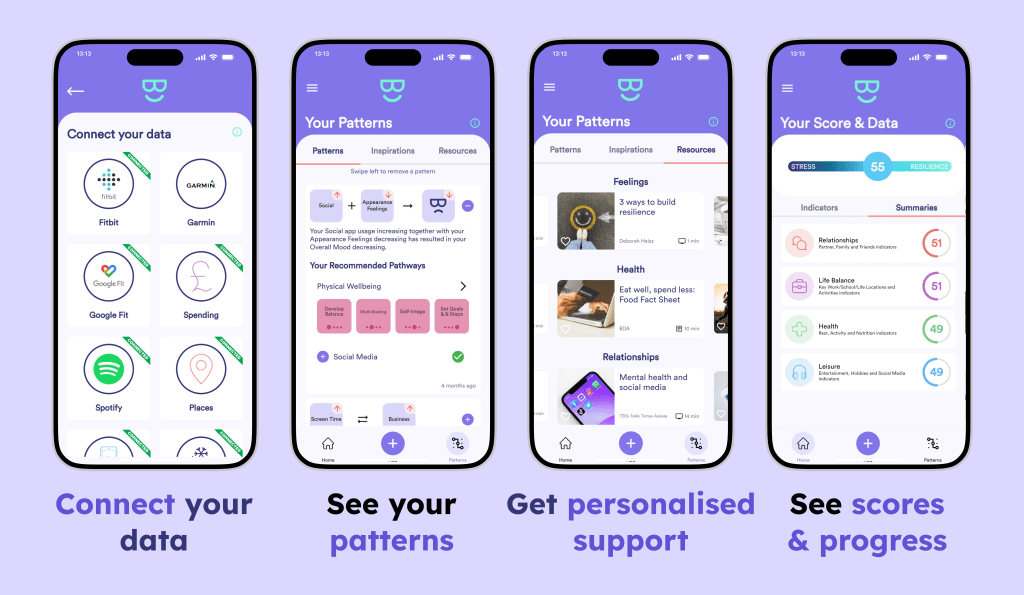
So, that was the beginning of the idea, which we’ve now turned into a technology and app that integrates people’s personal data holistically across pretty much everything in their lives. It does this securely, with all the data encrypted, and our subscription business model is transparent because we don’t have any advertising or data sell-on.
The app is based on artificial intelligence that identifies our emotional triggers and behaviour patterns, pinpointing correlations and causation, and then links you to pathways that provide specific support. For example, if your coffee intake was up and your sleep was down, it would link you to ways to manage your caffeine intake and your sleep schedule. That’s an obvious example, but as the app learns more about you it picks up more subtle personal triggers and patterns affecting your stress
The app can be accessed for individual users on iOS and Android, but companies are also using it. We provide an aggregated dashboard for organisations, which is all anonymised, but it helps them track emotions and dynamics across the organisation. If, for example, they see that a lot of their employees are struggling with financial well-being, they can beef up their own support in those areas, in addition to people accessing the pathways on Beam.
That sounds really innovative and like a useful tool for people to manage their mental health! You talked about it a little already, but could you expand on what inspired you to start your business?
I’d always felt a nagging sort of angst. I tended to catastrophise things, and I was also working for a big company where it was highly stressed and competitive. I found myself increasingly angry, and I wasn’t particularly present with my kids. Then I had a road rage incident, which was totally my fault and out of character. There was nothing physical, but I thought “my God, you fool, you could’ve been hurt just because you didn’t have your emotions under control”. I went home and told my wife, who agreed with me and was angry that I’d gotten involved in something like that when we’ve got a family to think about.
That gave me a deflated realisation, where I thought, what am I doing? I was going around getting angry, and I’d tried so many ways of managing my stress over the years, but nothing had worked. I’d used apps that were okay, but they required too much input and would give me tips that were too general, like mindfulness or meditating. I went to the doctor who said I was depressed. I didn’t feel depressed though, I just wanted to understand why I felt the way I did.
The only way I ended up coping was by sitting down for half an hour a day and doing a basic mind-dump onto a piece of A4 paper, writing down everything I felt stressed about. Like: my parents aren’t well, my child is struggling at school, will I get that bonus, why am I eating so much chocolate? It helped me see the obvious patterns, and that sparked the idea for Beam. I worked in a business where we used people’s data to serve them advertising, but I realised there are ways to let people use their data for their benefit instead.
That’s really inspiring to hear, how you found a way to manage your own stress and then turned it into a business to help other people. What has the business journey been like so far? What have been the challenges and the wins along the way?
It’s been tough. I came from a senior, pampered, corporate world, and I underestimated the challenges of running my own business. A friend of mine runs a business and he told me that it’s going to take more time and money than I think. I thought “no, no, no I’ll get there”, but of course, it’s taken more money and time than I thought. I made a few expensive and painful mistakes at the start, and I’ve learnt a lot along the way.
Despite the challenges, it’s been an inspiring journey, because I’m passionate about it. Seeing the first prototype of the app was very emotional for me – it was basic, but it was the concept in practice. As we’ve grown and developed our product, we’ve got more partners as well. We started with universities first, but now we have companies and the NHS as partners. They’re big fans of what we’re doing, because Beam is about preventative, self-directed support.
However, as much as this is a project I’m passionate about and I want to help people, I’ve invested my own money in the business, and I want a return on that investment for myself, staff, and investors. That means that I’ve worked really hard to make the most with the money we’ve had, and I think that’s a big reason why we’ve started making money now. I think that desire to make money from your business is sometimes seen as a bit of a “dirty” sentiment in Britain. But a business is both passion and profit.
To sum it up I would say, it’s been tough, brilliant, energising, and thank God I’ve done it. When I started the journey, I spoke to my wife and kids about it and said that it’s going to be a change. My wife’s response was: “you have to do this; you will regret it forever if you don’t try and make this real because it’s a great idea”. So yeah, I love it, but it’s not easy.
You’ve been part of our LONDON E-Business Support Programme, to get support with growing your business. What support have you received and how has that helped you?
Let me put this in context. I tried to get support much earlier on from other startup support services, and frankly a lot of them were useless to me. They talked theoretically about things I could do, but I didn’t feel like anything was practical or real, and it felt like a waste of my time.
The thing I’ve loved about the last six months is that you’ve put me in touch with contacts. I’ve spoken to an investor about my pitch deck. He hasn’t talked in generalities; he has gone into detail. He spent time to talk to me. You’ve helped me with digital marketing, with research, and linked me with other businesses who could further our research. This is all real, practical support. I love that, and I haven’t come across that before. From the people I’ve talked to, you really stand out.
What does the future hold for you and Beam now?
The truth is, I don’t know exactly what the future looks like. I know it’s going to involve growth, but I don’t know if the main growth is going to come from companies or through developing joint programmes with healthcare services, or both or something else.
For now, we’re just focusing on developing the product. We’ve got an evolved product coming out by the end of November, which will have lots of new, exciting features. Eventually, once we’ve grown a bit more, I’ll go for external investment, but I want to maintain control in the business. I’d rather spend my own money on realising the vision than have to compromise.
So the future is incredibly exciting because there’s nothing like Beam. We can predict emotions to over 80% accuracy, and the reason we can do that is that we have access to all these holistic data points. And that sentiment is echoed by our users, the people we work with, and our partners.
It’s been great to hear from you, and interesting to see how you’ve managed to create something so unique! As a final question, what advice would you give to someone starting their own business?
The main thing I would say to someone who is still thinking about it is that there will always be very logical reasons why you shouldn’t do it. But you must, if you genuinely believe in it.
I would also say, be realistic about time frames. When you’re excited about an idea, you assume everything is going to go to plan, but it won’t, and you have to be prepared for that.
It’s kind of obvious, but the people you work and collaborate with are really important. Be very diligent about weeding out those who won’t actually help you and only work with those who will.
The last thing I’d say is cut out the noise. There are so many people in the startup world who’ve never started anything, but they still have really strong views. Cut all that out and listen to the people who have experience and can give you sound advice.
Learn more about Beam
Website: https://beamandme.com/
Connect with Peter: https://www.linkedin.com/in/peter-magnani-5537a770/

*We strive to do our best when supporting small business and their growth. Our business databases can give you information and data that can help you with advertising, market research, company information, and industry factsheets. If you have already taken the plunge, we would love for you to join us at a seminar, our workshops cover digital marketing, business model canvas and planning, demystifying taxes and intellectual property to name a few. Visit our events page or website for more information.
 Small Business Research and Enterprise