

By: Ester Demideh, Emotional Intelligence Coach and Mentor
What is perfectionism?
One definition of perfectionism is “setting of excessively high standards for performance accompanied by overly critical self-evaluation” (Frost et al).
However, I personally prefer a more practical breakdown provided by the Centre for Clinical Interventions (CCI), which defines perfectionism through three key signifiers:
- A persistent striving for extremely high standards (even from an outsider’s perspective).
- A sense that your self-worth is tied to your ability to strive for and achieve these high standards.
- The continued pursuit of these demanding goals despite negative consequences, such as stress, burnout, or avoidance.
Identifying where you stand
Three dimensions to perfectionism
Understanding the type of perfectionism, you experience can help you address it more effectively:
- Socially prescribed perfectionism
External pressures and expectations placed on you by stakeholders, clients, or societal norms. You may feel like you must succeed to be accepted. - Other-oriented perfectionism
When you project your perfectionistic expectations onto others like your team or collaborators leading to conflict, micromanagement, or strained relationships. - Self-oriented perfectionism
Setting unrealistically high standards for yourself and being harshly self-critical when you fall short.
Perfectionism on a spectrum
Having high standards is not inherently bad. The trouble begins when those standards become inflexible and harmful. Many psychologists distinguish between adaptive (helpful) and maladaptive (unhelpful) perfectionism. Here’s a table to illustrate the difference:
| The spectrum for reaching high standards | |
| Adaptive perfectionism / Helpful perfectionism: | Maladaptive perfectionism/ Unhelpful perfectionism: |
| – Excellence seeking – Gets pleasure from achieving high standards – Standards are achievable, mistakes are allowed as and when; less likely to experience psychological distress – Achieving high standards fits around your life – Your self-worth is based on many things | – Failure avoiding – Striving to meet them has negative reinforcement and self-defeating behaviours – Minimal latitude for mistakes – Vague understanding when a task is complete – Your life fits around achieving high standards – Your self-worth is based on meeting your standards |
Pause for a moment: Are your current behaviours helping or hindering your business?
If your high standards are working for you and fuelling growth without stress, this blog may not apply. But if you’re noticing burnout, stalled progress, or reduced joy, read on. From here, “perfectionism” refers to the unhelpful kind. You can click here to take a short quiz on perfectionism.
Why perfectionism is so dangerous for entrepreneurs
High standards aren’t the problem; it’s the constant pressure to achieve an ideal of “perfect” that’s often vague and unattainable. This leads to unsustainable behaviours that drain your energy, damage your wellbeing, and sabotage your business.
Maladaptive perfectionism is especially dangerous because it’s a moving target. You sacrifice rest, joy, and connection for a goal you can’t define, let alone reach.
The real-life consequences of maladaptive perfectionism
This kind of perfectionism has been linked to a range of issues, including:
- Social isolation
- Frustration, worry, and depression
- Disordered eating
- Relationship difficulties
- Obsessive-compulsive behaviours (e.g. repeatedly checking work)
- Chronic procrastination
- Insomnia and burnout
- Persistent feelings of failure
- Physical health problems
So it’s more than being “a bit hard on yourself.” It can erode your quality of life.

What the research tells us
Researcher David Burns administered a questionnaire measuring perfectionistic attitudes to 34 high-performing insurance agents at the Philadelphia Million Dollar Forum, with salaries ranging from $29,000 to over $250,000.
Out of the 34:
- 18 agents exhibited strong perfectionistic thinking styles
- 16 agents were categorised as non-perfectionistic
The researcher expected that the perfectionistic agents, especially those who tied their self-worth to productivity would earn the most. However, the perfectionists earned an average of $15,000 less per year than the non-perfectionists (Burns, 1980).
Despite working just as hard (if not harder), these perfectionists were not seeing greater financial results. Their mental habits were, in fact, costing them economically and emotionally.
Another study by Andrew W. Meyers at Memphis State University backed this up in the world of racquetball. Meyers found that less-skilled players were more likely to:
- Set rigid, perfectionistic standards
- Struggle to recover from mistakes
What is this telling us? Perfectionism doesn’t guarantee success. In many cases, it hinders it.
On the other hand, those who allow themselves to learn from mistakes, stay flexible, and focus on progress over perfection tend to go further, both professionally and personally.
Why “good enough” wins
This doesn’t mean abandoning ambition, but “perfect” isn’t where growth lives. Sustainable progress is.
Flow vs. fear
Research shows that “flow”, a productive, focused state, is more likely when you’re immersed in meaningful, challenging tasks without the fear of failure. Adaptive perfectionists stay open and engaged. Maladaptive perfectionists get stuck in self-criticism and avoidance, which kills flow.
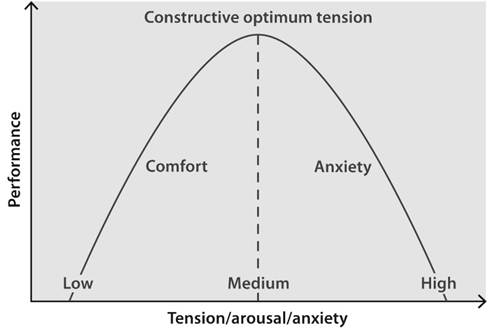
The Yerkes-Dodson Law
Too little pressure, and we’re bored. Too much, and we’re overwhelmed. Complex work like launching a business thrives under moderate arousal where you can be in a “flow” state. Constant pressure to be perfect disrupts this balance, leading to poor outcomes.
From perfection to practical
So, what does “good enough” actually look like? Hint, you’re not looking for flawless, but you’re looking for effective. That shift reduces anxiety, increases creativity, and gives you permission to grow through experimentation.
A practical tool: The Lean Model Canvas
You’ll be spending most of the early phase of starting a business figuring out what problem you’re solving, not perfecting every part of your offering. This demands space for error, feedback, and adaptation. The Lean Model Canvas is a streamlined version of the Business Model Canvas; a practical strategy tool that helps entrepreneurs test ideas quickly.
The Lean Canvas is your space to do that. Start there. Build something that works. Then iterate.
Applying ‘good enough’ thinking in practice
The Lean Canvas is a great tool for refining a service or product. It helps you focus on:
- Your customer’s top 3 problems
- The solutions you offer
- Existing alternatives
- Your unfair advantage
This user-first approach helps perfectionists shift focus from “getting it perfect” to solving real problems, the only path to building a viable business.

To break the perfectionism-performance loop, try these:
Let good be good enough
Perfectionism thrives on all-or-nothing thinking. Instead, treat each task as an experiment:
- What can I do with the time and energy I actually have?
- What’s enough for today?
- What 3 tasks are realistic — not ideal?
Redefine your value beyond work
When worth = output, burnout is inevitable. Expand your identity by:
- Doing pro bono work
- Building community that values you
- Starting non-monetised hobbies
Many people become entrepreneurs to experience freedom. So why replicate the same pressure from the traditional system? So, ask yourself: Am I using my freedom for joy, rest, and connection or just performance?
Reflect through daily journaling
Shift how you track growth:
- What did I do today?
- What strengths did I show?
- What’s the evidence I’m growing, even if it’s not perfect?
Below is a simple exemplar template I share with coaching clients to help reframe perfectionist thinking and rebuild confidence through action and self-reflection, you might want to give it a go:
| Prediction: ‘I will get around 500 followers on my Instagram’ | ||
| Day/Date | What I did (evidence) to make this belief even more true: | What positive quality about myself did I show or feel? |
| 05/02/25 | Today I researched popular content creators in my industry, this will increase the chance for my prediction (i.e people buying my services) to be true as I learnt the current trends in my target consumers behaviour. They tend to like topics to do with positive affirmations, which gave me an idea to tie affirmation in my content strategy alongside this unique (so and so) so I can reach my audience needs and give them more than what already exists. Doing this could increase demand for my services. | The positive quality I showed was initiative and I feel I’ve also developed a soft skill in research. I was scared to see what my competitors were up to but I realise when looking at the beginning of their journey that we all start from somewhere and it was actually kind of reassuring to see that it doesn’t have to be perfect from the beginning. |
You’ll be amazed at what changes when you start tracking progress, not just perfection.
Final thoughts
You are not better or worse than anyone else – just on your own path. Don’t let the pursuit of perfection take the joy out of what you love. Progress matters more than flawlessness, and growth doesn’t have to come with constant pressure.
If this resonated with you, feel free to book a free 15-minute discovery call here to explore what EQ-informed coaching for founders could look like. Or, join my community The Emotionally Intelligent CEO on Enterprise Nation here
References:
Kamushadze, T., Martskvishvili, K., Mestvirishvili, M., & Odilavadze, M. (2021). Does Perfectionism Lead to Well-Being? The Role of Flow and Personality Traits. Europe’s journal of psychology, 17(2), 43–57. https://doi.org/10.5964/ejop.1987
Burns, D.D., 1980. The perfectionist’s script for self-defeat. Psychology Today, November, pp.34–52.
*We strive to do our best when supporting small business and their growth. Our business databases can give you information and data that can help you with advertising, market research, company information, and industry factsheets. If you have already taken the plunge, we would love for you to join us at a seminar, our workshops cover digital marketing, business model canvas and planning, demystifying taxes and intellectual property to name a few. Visit our events page or website for more information.
 Small Business Research and Enterprise