
By: Veronica Broomes PhD Founder of the Sustainability Support Service and Help to Grow Business Mentor
Understanding sustainability: It is much more than a buzzword
Are you a start-up business founder eager to cultivate enduring growth and long-term viability? Or perhaps you are driven to gain a significant competitive edge? Then, continue reading as the article delves into how proactive sustainability integration can propel your business without straining your resources.
Sustainability can be defined as: “Actions that take account of economic, social and environmental considerations to ensure today’s actions do not destroy resources available for future generations.” At its heart lies the principle of minimising resource consumption, profoundly influencing how energy, water, and materials are utilised across the entire value chain.
By embracing sustainable business practices, startups can significantly diminish their carbon and water footprints while simultaneously enhancing energy efficiency.
The foundational pillars of sustainability are typically identified as environmental (Planet), social (People), economic (Profit), and governance (G). Whether articulated as ESG (Environment, Social, Governance) or ESEG, the concept extends far beyond mere carbon reduction initiatives or symbolic tree-planting endeavours. It represents a comprehensive commitment to responsible and ethical operations.
A deep consideration for the human impact encompass crucial social dimensions such as bolstering staff retention, attracting top-tier talent, and rigorously preventing human rights abuses in supply chains.

The circular advantage: Minimising waste, maximising value
In the realm of waste management, startups possess a unique opportunity to champion a ‘circular economy’ ethos. This involves proactively minimising waste generation at its source and actively diverting waste away from costly landfill sites.
The ‘circular economy’ concept champions initiatives that repurpose waste streams, transforming them into valuable resources for new products rather than consigning them to landfills. While the conversion of waste into new products such as transforming plastic cups into pens, for example, represents one facet of this circular economy approach. However, the most impactful strategies lie in prevention: buying less and designing products with waste reduction as a primary consideration.
As you embark on your startup journey, consider the substantial long-term financial benefits accrued from simple yet impactful choices, such as reducing paper consumption or optimising the use of printer ink cartridges.
Sustainability: A catalyst for innovation and creating a competitive edge
Integrating sustainability into the foundational stages of your startup’s operations can yield substantial and enduring advantages. This strategic foresight can spark innovative changes across a spectrum of business functions, including: i) processes, ii) new technologies, iii) operating methods, iv) systems, v) products, vi) services, and vii) management approaches.
The sheer breadth of opportunities for innovation within sustainability can unlock novel solutions to existing challenges, such as optimising resource utilisation and transforming waste into valuable raw materials. These innovative approaches can address specific company issues or even tackle broader industry-wide challenges.
Therefore, sustainability should be viewed not merely as a cost centre but as a strategic imperative that can ‘future-proof’ your business and provide a significant competitive edge. The ability to develop a customized roadmap towards achieving this is an invaluable asset.
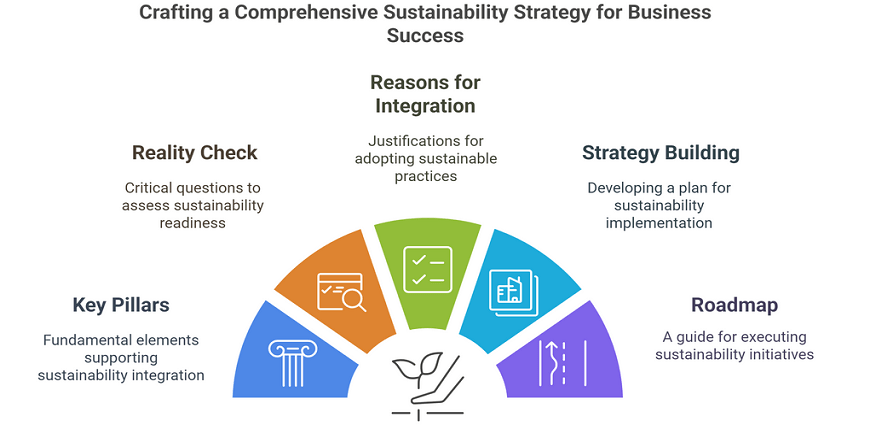
Crafting your sustainable roadmap to success in your start-up
Integrating sustainability can also unlock opportunities in procurement processes. Legislation increasingly emphasises the importance of ‘social value’ in publicly funded projects, requiring businesses to demonstrate positive community impacts.
For startups providing services or products through tenders or framework contracts with major corporations, retailers, or government agencies, a cohesive integration of the environmental and social pillars of sustainability is paramount. Success in these competitive environments necessitates a shift from siloed approaches to a demonstrable commitment to reducing carbon emissions, improving work-life balance for employees, and actively planning for a transition to a low-carbon economy.
Therefore, for startups like yours aspiring to secure contracts and foster long-term job security, the integration of sustainability is not just advisable, it is essential.
Your next steps: embracing the advantages of sustainability
Businesses that strategically place sustainability at their core adopt a holistic perspective that transcends the traditional “single bottom line” focused solely on profit.
Undertaking an early and realistic assessment of the relevance of sustainability, for example a sustainability audit, and identifying potential benefits for your startup are crucial steps for action-oriented founders. Indeed, integrating the principles and practices of sustainability in the early stages of your business can result in financial savings through operational efficiencies, new revenue streams through process, service, or product innovation, and ultimately enhance competitiveness. Beyond these tangible benefits, a commitment to sustainability secures not only the jobs in your business and your livelihood, but also paves the way for consistent and enduring business growth.
The Sustainability Monthly newsletter: https://drveronicabroomessustainability.substack.com/subscribe
LinkedIn page: https://www.linkedin.com/company/sustainability-support-for-business/
Bluesky app: https://bsky.app/profile/sustainability4u.bsky.social
*We strive to do our best when supporting small business and their growth. Our business databases can give you information and data that can help you with advertising, market research, company information, and industry factsheets. If you have already taken the plunge, we would love for you to join us at a seminar, our workshops cover digital marketing, business model canvas and planning, demystifying taxes and intellectual property to name a few. Visit our events page or website for more information.
 Small Business Research and Enterprise